Ask someone how they'd research a health concern today, and a doctor's appointment probably isn't step one anymore. It's more likely to start with a Google search, a TikTok video, a Reddit thread or a question typed straight into an AI assistant.
That shift, from one trusted source to many, is reshaping consumer health trends faster than many brands and insight teams can track them. Here's what's driving it, and why quantitative data alone can't keep up.
Imagine someone who's been feeling unusually tired for a few weeks. Before booking an appointment, they ask ChatGPT whether poor sleep could be to blame. They watch a couple of TikToks discussing sleep hygiene, browse Reddit to see whether other people have experienced something similar, read an article from a supplement brand and ask a colleague what worked for them. By the time they speak to a healthcare professional, they've already built an understanding from several different sources.
That doesn't mean people trust doctors any less.
It means consumers no longer build health beliefs from a single authority. Instead, they're increasingly creating their own hierarchy of evidence, weighing professional advice, lived experience, AI-generated information and personal recommendations before deciding what to do next.
This shift has fundamentally changed how consumer health trends emerge, spread and influence behaviour. Through consumer health research projects, we've seen participants describe journeys that draw on multiple sources before a decision is made, with different influences becoming more important at different stages of the process.
Consumer health decisions are shaped by more voices than ever before
Consumers are taking a more proactive approach to their health. They're tracking their sleep, researching ingredients, comparing products and taking a greater interest in preventative wellbeing. In PwC’s 2026 survey of consumers across 27 countries and territories, 80% said they used an app or wearable for at least one health and wellness activity.
A typical consumer health journey might include:
- A healthcare professional or pharmacist offering advice about a condition, treatment or product
- Social media content introducing an unfamiliar idea
- AI helping someone make sense of terminology or compare options
- Online communities and reviews offering other people’s experiences
- Friends and family sharing recommendations
- Apps and wearables prompting someone to pay attention to a change in their routine
These sources play different roles. A video may spark curiosity, while a pharmacist’s advice helps someone decide what to do next. Someone else may find an online discussion reassuring but remain sceptical of a brand’s claims.
Our article on AI and consumer behaviour looks more closely at AI’s role. Here, the wider point is that one source rarely explains an entire decision.
More information doesn't always mean better information
It is easier than ever to find information about nutrition, wellbeing and health products. It can be much harder to work out what deserves your trust.
Algorithms personalise what everyone sees, so two people researching the same thing can end up with completely different pictures. Influencer partnerships blur the line between education and advertising. AI answers can also sound certain when the underlying information is incomplete or wrong.
One study of nutrition-related TikTok posts found that 36% of the posts it assessed were completely accurate. The researchers also identified problems with disclosure, supporting evidence and the presentation of risks and benefits. While the findings relate specifically to the posts studied, they highlight a wider challenge for consumers: the popularity of health content on social platforms does not necessarily reflect its quality or reliability.
That isn't to suggest platforms like TikTok have no value. They've helped make health information more accessible and opened conversations around topics such as menopause, gut health and nutrition.
The challenge is that consumers are increasingly responsible for deciding which information to trust.
For a researcher, a useful follow-up is simple: what did someone believe when they first encountered a claim, and what changed their mind?
Consumer health trends now move faster than brands can track
If modern health decisions are shaped by multiple influences, it's no surprise that consumer health trends are evolving faster than ever.
Creatine offers an example. Once associated mainly with bodybuilding and strength training, it now appears in wider conversations about fitness and wellbeing. Our Google Trends comparison also shows increased UK search interest in “creatine gummies”.
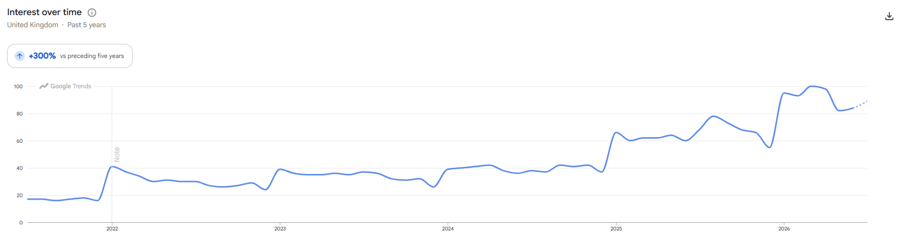
(UK Google Trends search interest in “creatine gummies”. Screenshot retrieved 8 July 2026. The most recent five-year period is compared with the preceding five years; Angelfish’s analysis of the screenshot indicates an increase of approximately 300%. Google Trends shows relative search interest, not the number of searches or purchases.)
That chart is a useful signal. It cannot tell us who is searching, whether they intend to buy, or what prompted their interest.
Some consumers may first hear about creatine from a fitness creator explaining its benefits. Others discover it through articles about healthy ageing or increasing protein intake. They may then compare product information, read other consumers’ experiences or ask a professional a question. These are possible journeys, not an explanation that can be inferred from the chart alone.
The same distinction matters when looking at changes in behaviour. In our GLP-1 consumer insights pulse, respondents described different motivations for using treatment and changes in what mattered when choosing food and drink. Their answers add context that a headline about category growth would miss.
Sales figures, search data and social listening can reveal what is happening. Speaking to people can help explain what those signals mean in their lives.
Why qualitative research has become essential
Rather than asking whether someone bought a product, qualitative research explores everything that happened beforehand.
- Where did they first hear about it, and what made them take notice?
- Which sources built trust, and which raised doubts?
- What changed between considering the product and deciding to buy it, seek advice or walk away?
Those answers are rarely straightforward.
Someone might discover a supplement through social media but only feel confident buying it after reading independent reviews and speaking to a healthcare professional. Someone else might do all the same research and decide against it. Both journeys are useful to understand.
That's why methodologies such as in-depth interviews, focus groups, digital ethnography, online research communities and accompanied shopping have become increasingly valuable. They reveal not only what consumers are doing, but how different touchpoints interact throughout the decision-making process.
Looking beyond the trend
Today's consumer health journeys rarely follow a straight line. People move between expert advice, lived experience, digital content and AI-generated information before making decisions about their health. What matters is how they weigh those sources in their own circumstances.
A trend might tell you where to look. The people behind it can help you understand what is changing, what is holding them back and what they need before they act.
At Angelfish Fieldwork, we help our clients go beyond the headline data to understand the people behind it. If you’re planning research into a health or wellbeing product, our consumer health market research recruitment page explains how we help you find participants with the experiences your project calls for.