.png)
Should children under 16 be banned from using social media?
It's a question we're likely to hear a lot more over the coming months.
In June 2026, the UK Government announced plans to prevent social media platforms from offering their services to under-16s, with the new protections currently expected to come into force in Spring 2027. Similar restrictions are already in place in Australia, where age-restricted social media platforms must take reasonable steps to prevent under-16s from holding accounts.
There are plenty of opinions about what this could mean. But we wanted to hear from the people closest to the conversation – including children themselves.
So, we’ll be following attitudes towards the proposed UK social media ban as the policy develops, hearing from parents, teachers and SENCOs, children and older teenagers.
The people taking part are members of our Angelfish Opinions community who have opted into our dedicated Social Media Ban Pulse community to share their views as the story develops.
And rather than asking once and moving on, we'll be coming back to some of the same questions. Do people still support the ban? Do they think it can actually be enforced? Are families changing their behaviour? And does the gap between what adults and children think change as we get closer to Spring 2027?
Pulse 1 gives us our starting point – and there are already some interesting differences.
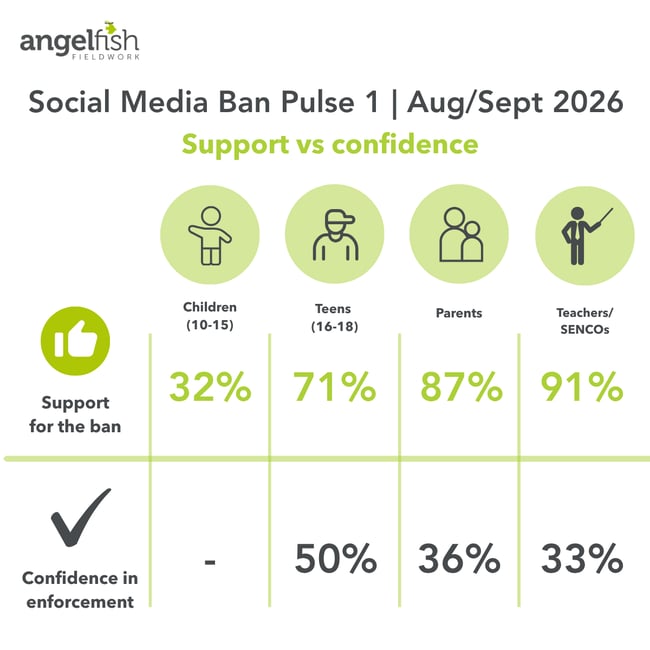
Pulse 1 at a glance
- Parents: 87% support the proposed ban, but only 36% are confident it can be successfully enforced.
- Teachers and SENCOs: 91% support it, while just 33% are confident it can be enforced.
- 16–18-year-olds: 71% support the proposal and 50% are confident it can be enforced.
- Children aged 10–15: 32% think the ban is a good idea, while 45% think it's a bad idea.
One of the clearest themes from our first pulse? Supporting the idea of a ban and believing it will be enforced aren't necessarily the same thing.
Nine things that stood out from Pulse 1
1. Parents are overwhelmingly in favour
87% of parents support the proposed ban, with 59% saying they strongly support it.
But only 36% are confident it can be successfully enforced, compared with 47% who aren't confident.
2. Harmful content tops parents' list of worries
55% of parents selected exposure to harmful content as one of their biggest concerns about children's social media use.
Mental health was close behind at 54%, followed by online bullying (42%), addiction or excessive use (38%) and contact with strangers (32%).
3. Some families are already changing their behaviour
The ban is still only a proposal, but 46% of parents have already changed their household rules around social media at least a little since hearing about it. That feels significant at such an early stage, before the proposed restrictions have even come into force.
4. Parents still see themselves as having the biggest role to play
Despite their strong support for intervention, 59% of parents said responsibility for protecting children online mainly lies with parents themselves.
That compares with 24% who believe responsibility should be shared, 9% who selected social media companies and 6% who selected government.
5. Teachers and SENCOs are even more supportive
91% of teachers, SENCOs and other school staff support the proposed ban.
Yet confidence is lower again: only 33% believe it can be successfully enforced.
6. Social media issues are already a regular part of school life
26% of school staff told us they deal with issues originating from social media every day, with another 39% dealing with them weekly.
In total, 65% encounter social-media-related issues daily or weekly, rising to 79% who experience them at least monthly.
7. The impact on children with additional needs is less clear-cut
When we asked teachers, SENCOs and other school staff whether the ban would particularly affect children with additional needs, 25% said yes, 44% said no and 32% weren't sure.
Their comments showed just how complex the issue is. One education professional in the North East felt that children with additional needs “are already more vulnerable and need greater protection.”
But another respondent in London highlighted what could be lost, explaining that some young people with additional needs can be isolated from their peers and that “in some cases connecting with similar students online is their only means of social interaction.”
8. Children are much less convinced by the idea
Among children aged 10–15, 45% think the proposed ban is a bad idea, compared with 32% who think it's a good idea. Another 23% aren't sure.
Opposition was even higher among 13–15-year-olds, with 53% saying it's a bad idea. This is particularly interesting as this group is closest to 16, meaning they’ll likely feel the impact of the proposed restrictions most immediately.
9. But that doesn't mean children think social media is all good
Across our full 10–18 child sample, 59% described social media as a mixture of good and bad.
And for those who use it, social media isn't just about scrolling. 82% use it to talk to friends, 45% to follow hobbies and 42% for learning, alongside watching videos, entertainment and gaming.
Children themselves recognise that social media has downsides – they're just not necessarily convinced that banning access is the answer.
This is just our starting point
Pulse 1 gives us our baseline. Now we get to see what changes.
Over the coming months, we'll be returning to our Pulse community as the policy develops and Spring 2027 gets closer.
Will support remain this high? Will people become more confident about enforcement? Will more families change their rules at home? And will children become more – or less – convinced?
We'll be sharing what we find along the way.
Keep an eye out for Pulse 2 coming soon.
About the research
Pulse 1 was conducted by Angelfish Fieldwork in August 2026 through our Angelfish Opinions community.
We heard from parents and guardians, teachers, SENCOs and other school staff, children aged 10–15 and a separate group of 16–18-year-olds.
Question wording differed slightly between audiences.