
UK retail sales volumes rose by 1.3% across 2025 (in-store and online), according to the Office for National Statistics – the second year in a row they've increased. People are still shopping. But understanding how and why they make the decisions they do? That's where brands often fall short.
Sales data tells you what happened. Surveys tell you what people think they did. Neither tells you what it actually looked like in the moment – the hesitation at the shelf, the product that almost made it into the basket, the fixture that confused everyone.
That's the gap accompanied shopping research is built for.
It's also a method we find researchers sometimes feel uncertain about using. There's a worry it'll be awkward, disruptive, or difficult to manage. In our experience, it's rarely any of those things. Done well, it's one of the most natural research experiences you can offer someone, as well as one of the most valuable for the teams that commission it.
But it's not the right approach for every project. So this article offers a practical look at when accompanied shopping research works, and when another method might work better for you.
What is accompanied shopping research?
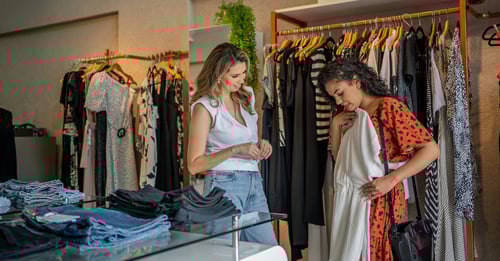
Accompanied shopping research (also known as shop-alongs, assisted shops, or ASTs) involves a researcher joining a participant on a real shopping trip, observing behaviour as it happens and asking light questions in the moment.
The point is immediacy. Participants aren't reconstructing what they did last Tuesday. They're navigating real shelves, real pricing, real distractions and the researcher gets to see it all in realtime.
You can find a fuller overview on our accompanied shopping page.
It's also worth saying that 'shopping' doesn't have to mean a supermarket. We've run accompanied trips in garden centres, homeware stores, museums and high-street restaurants. Wherever a real environment is shaping the decisions people make, the methodology translates.

When accompanied shopping research is the right call
The question to ask isn't 'would this be interesting?' (because from our experience, it is), rather, the more useful question is: does the context of the decision matter to what we're trying to understand?
Here's where it tends to work well.
When behaviour matters more than stated opinion
There's a well-documented gap between what people say they do and what they actually do. In a focus group or depth interview, participants are working from memory and often constructing a more rational version of a decision that was, in the moment, instinctive. Accompanied shopping removes that reconstruction. You see the real choice, not the edited version of it.
When decisions are habitual or hard to explain
A lot of purchasing behaviour is automatic. People reach for the same brand week after week without really knowing why. Ask them in a debrief and they'll give you an answer, but it may not be the real one. Being there in the moment gives you a much better shot at understanding what's actually driving behaviour.
When the store environment is central to the question
If you're trying to understand how layout, navigation, signage or product placement is affecting choice, you need to be in the store. You can't replicate the moment someone walks past a promotional display without noticing it, or spends 40 seconds looking for a product that should be obvious. Those moments only exist in context.
When sales data shows a pattern but not the reason
We see this a lot. A product is underperforming but nobody can say why. Is it shelf position? Pack design? How it sits next to a competitor? Accompanied shopping bridges the gap between what the numbers show and what's actually happening on the shop floor. It gives the 'why' to go with the 'what'.
When client teams need to see behaviour for themselves
There's something that shifts when a decision-maker watches a real person navigate a store in real time. A well-written findings report can summarise it. But it doesn't create the same sense of shared understanding, or the same momentum.
We've seen this first-hand. In a project for a longstanding home retail client, we combined accompanied store walks with a client-facing workshop. Because the workshop followed immediately after the in-store session, participants were still talking about decisions they'd just made. The client team could ask questions, probe in real time, and leave with a shared picture of their customers that no slide deck could have created. Internal debates that had been running for months resolved quickly, because people had seen the behaviour themselves – not read about it.
When a different method might be a better fit
Choosing accompanied shopping when it isn't the right approach doesn't do anyone any favours. Here's when we'd usually suggest looking at alternatives.
When the purchase is infrequent or hard to replicate
Accompanied shopping works best when the trip happens naturally and regularly enough to recruit around. If you're looking at a category where decisions happen once or twice a year, such as furniture, big-ticket appliances, or holidays, depth interviews or in-home ethnography will usually give you richer material. You're better off exploring the decision in detail than trying to engineer a replication of it.
When the physical environment isn't central to the question
If what you're really exploring is attitudes, brand relationships, or broader lifestyle context, the store isn't where the most interesting stuff lives. Online qualitative research – whether that's depth interviews, focus groups or communities – tends to give you more space for that kind of exploratory conversation, without the logistics of organising a store visit.
When budget or timeline is the primary constraint
Accompanied research takes time to recruit, run and analyse. It delivers real value, but it's not the fastest or lowest-cost option. If speed is critical and context isn't central to your question, intercept interviews can get you into the field quickly and still capture in-the-moment behaviour.
When you want customers to help generate ideas
Accompanied shopping observes. It probes. It doesn't naturally create the conditions for structured creative input or co-creation. If that's what your brief needs, a customer workshop or digital ethnography approach might work better for you.
So, is it the right method for your project?
Accompanied shopping research is powerful when context and behaviour are at the heart of the question. When you need to understand what people actually do - not what they think they do – and when the environment they're in is part of the story, it's hard to beat.
If you're not sure whether it's the right approach for what you're working on, we're happy to talk it through. We work with clients at the brief stage to help them figure out which methodology is most suitable for their research, so their research gets the insights it needs.
Want to explore whether accompanied shopping research is right for your next project? Get in touch with our team.

.png)